Walk Ride Bath raised concerns about the route through Royal Victoria Park in 2024. B&NES has now admitted that our later formal objection never reached the person deciding the TRO. With work already under way and £2.35m authorised, we need to know what happens next.
We spent weeks putting together our response to the Bath Walking, Wheeling and Cycling Links (BWWCL) consultation in November 2024. We looked at what worked, what needed improving and where the proposed routes failed to join up. We did that because we want Bath to have better walking, wheeling and cycling infrastructure, not because we want to hold it up.
One of our biggest concerns was the proposed cycle route through Royal Victoria Park. Nearly two years on, it remains the chosen alignment. And now we have discovered that our subsequent nine-page objection to the Traffic Regulation Order (TRO) was not considered at all by the original decision-maker.
What happened to the 2024 consultation?
The original public consultation ran for 13 weeks, into January 2025. B&NES says it listened and made changes. There have been adjustments to lighting, crossings, parking and access, and some of those improvements are welcome. The council also reported public support for parts of the scheme.
But the point we raised about the route itself has never been convincingly answered. Why take the strategic connection through a park when Weston Road could be assessed as a more direct, better overlooked alternative? And why leave gaps where the new route ought to meet cycling infrastructure that is already in place?
Our November 2024 consultation response set out these concerns in detail. We would like to see the council’s assessment of them. Which alternatives were tested? What evidence led officers to retain the park alignment? Almost two years have passed since we submitted that response. It is fair to ask what all that consultation actually changed.
A lit path is not necessarily a route people will use after dark
This was the main issue in our TRO objection.
The Department for Transport’s cycle design guidance, LTN 1/20, has warned since 2020 that routes through large, quiet parks may be poorly used after dark, even when lighting is provided. Paragraph 15.3.2 says a suitable street-lit on-road alternative should be considered.
That guidance was in place when B&NES consulted in 2024.
In March 2026, Active Travel England launched its Women and Girls’ Safety Programme. Research published alongside it found that 88% of women surveyed had felt unsafe walking alone after dark, and 71% had changed their walking route to avoid the dark during winter or darker months. Those are national findings about walking, not a survey of Victoria Park, but they underline why route choice and personal security matter.
Lighting will improve parts of the park. We welcome that. It cannot, by itself, provide the activity, overlooking and opportunities to leave a route that people may rely on to feel safe. A route through a tree-lined park, separated from the surrounding roads by fences and vegetation, needs to be assessed with that in mind.
Our TRO objection asked specifically about natural surveillance, sightlines, after-dark use and asked the council to identify the Equality Impact Assessment (EqIA). We are still seeking a clear explanation of how those issues influenced the decision to use the park.
Weston Road is worth a proper look
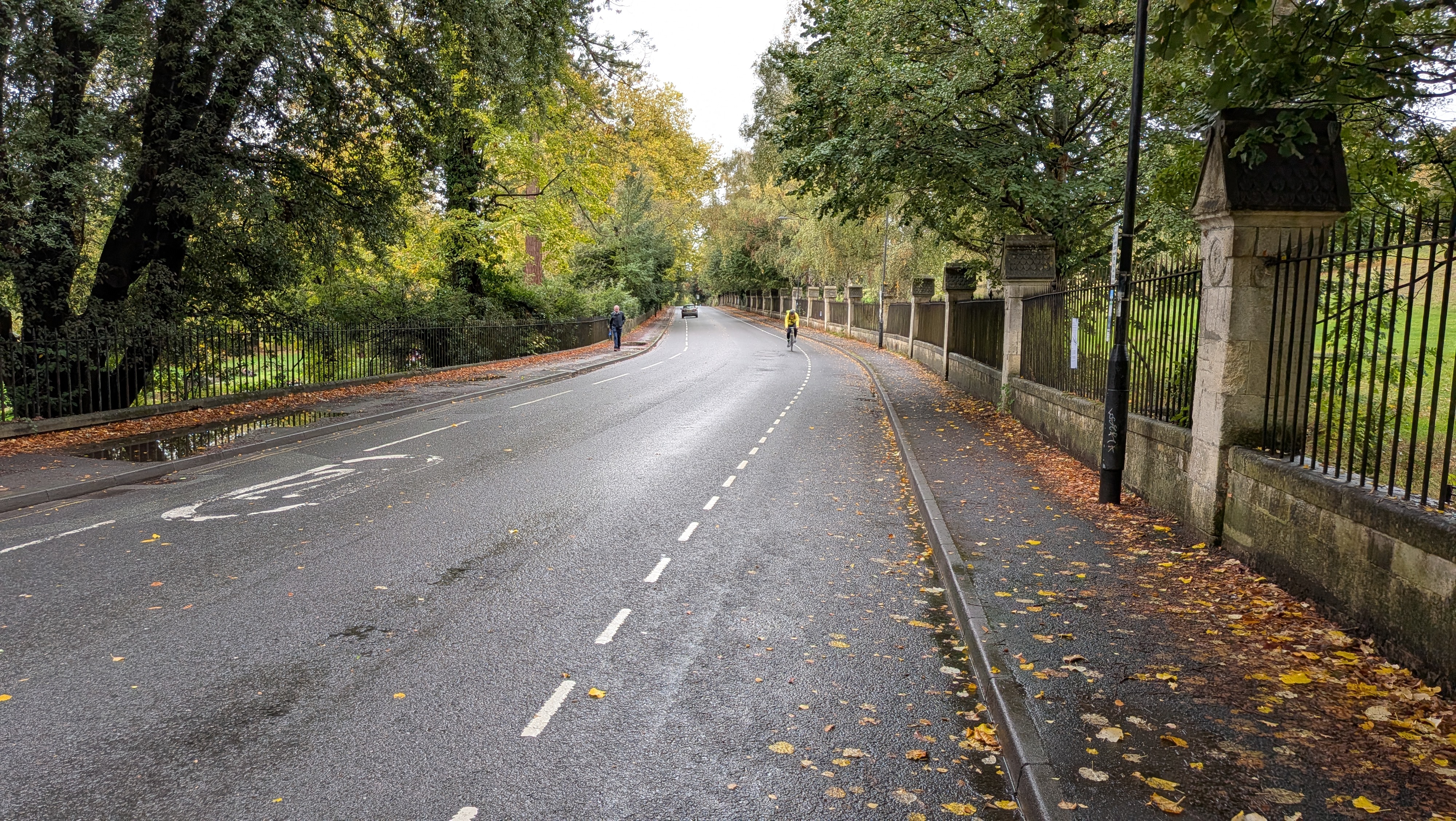
Weston Road, October 2026. A cyclist rides beside unoccupied parking bays. A photograph taken at one moment cannot tell us what parking demand is like across the day, but it shows why reallocation of road space is an option worth testing.
The picture shows a cyclist already using Weston Road. The road has lighting, passing activity and a potential direct connection towards Weston, the RUH area, Lansdown and the Circus Liveable Neighbourhood. It would need a proper assessment of traffic, parking, junctions and road safety before anyone could say what is feasible.
We are asking for that comparison to be made openly.
There is a separate local connectivity problem around Tennyson Road. People already cycle along it to avoid the Windsor Bridge junction, but how are they supposed to get from Tennyson Road to the proposed Victoria Park cycle track or the existing Upper Bristol Road cycle tracks? The scheme does not appear to address that practical connection.
The route towards Weston via Weston Road and Weston Park is a separate strategic question. Tennyson Road is about making the local network work for the people already using it.
We would keep the proposed cycling contraflow at the north-west entrance to the park. There are useful improvements here. They do not depend on treating the whole park alignment as the only possible route.
Then we learned our TRO objection had been missed
Our nine-page objection focused on the park route’s personal-security and equality implications, with references to national guidance and requests for the evidence behind the council’s decision. It was a formal submission, made in the statutory TRO consultation.
On 22 October, B&NES told us in response to a Freedom of Information request that our objection was not put before the decision-maker because of a “technical and administrative oversight”.
The council has revoked its previous delegated decision and says it will reconsider our objection alongside the others before making a fresh decision. Its official decision record is here.
That does not mean we have stopped the scheme or that the TRO has simply disappeared. B&NES has said the order had already been sealed, and we have asked it to clarify the legal status of that order and which works can proceed while the decision is reconsidered.
Whatever the outcome of the fresh decision, a formal objection should not be missed. Particularly one dealing with whether a route will be usable and welcoming to everyone.
Why was £2.35m authorised before that decision was complete?
The dates are important. The TRO consultation closed on 27 August 2026. On 11 September, WECA’s Executive Director of Transport approved an early-works application and authorised a drawdown of £2,350,216 for the Royal Victoria Park section. B&NES announced its original decision to proceed on 1 October, and contractors began work on 19 October.
WECA’s funding decision is public. It was a delegated officer decision, not a vote by the Transport Advisory Board. The approval came after consultation closed, but before B&NES had completed and publicly announced its original TRO decision.
Early-works funding can be approved before every stage of a scheme is complete. The issue is what safeguards WECA put in place when authorising money for works that depended, at least in part, on an unresolved statutory process. How much has actually been spent or committed? What happens if the final decision changes the scheme?
There is another reason for asking. B&NES’s 1 October announcement clearly included a segregated cycle lane. Its 19 October announcement about starting work focused on lighting, pedestrian routes and crossings, without mentioning the cycle track.
That could simply reflect the first phase of construction. We are not claiming the cycle track has been dropped. But now that the TRO decision must be revisited, the distinction matters.
Better paths, lighting and crossings are worthwhile, and they can deliver genuine walking and wheeling benefits. The £2.35m approval, however, was for early works on a strategic walking, wheeling and cycling connection. If the cycling element is substantially changed or does not proceed, WECA will need to explain how the money spent still meets the aims of the approved scheme. It should be able to show that to the Department for Transport as well as to local residents.
Seven questions we want answered
- B&NES: what happened to the 2024 feedback? Which of Walk Ride Bath’s concerns about the route were investigated, why was the park alignment retained, and why has it taken nearly two years to get to this point?
- B&NES: how was our formal objection missed? What checks failed, what is now the legal status of the sealed TRO, and which works can continue before a fresh decision?
- B&NES and Active Travel England: where is the safety assessment? How did the council consider LTN 1/20 paragraph 15.3.2, women’s and girls’ safety, natural surveillance and alternative routes in its design and equality work?
- B&NES: why has local cycling connectivity been overlooked? How are people cycling along Tennyson Road to avoid the Windsor Bridge junction supposed to connect into the proposed Victoria Park cycle track or the existing Upper Bristol Road cycle tracks? Why wasn’t this obvious local connection addressed as part of the scheme?
- WECA: what risks were accepted on 11 September? What conditions and contingency arrangements accompanied the £2.35m approval, and how much has actually been drawn down, committed or spent?
- Councillor Kevin Guy: what oversight took place? As B&NES Leader and chair of WECA’s Transport Advisory Board, was the Board briefed about the delegated funding approval and the outstanding TRO decision? If not, why not?
- WECA: what if the final scheme changes? If the strategic cycling connection is not delivered, how will the expenditure be reconciled with the original business case and explained in any Department for Transport audit?
We want this funding to deliver a useful network, not a collection of improvements that fail to join up. We also want the council to show that the time residents and groups put into consultation has an effect on the decisions made.
The council now has a chance to address the missed objection properly. We hope it also takes the opportunity to explain its original route choice and give the public a clear account of what the £2.35m is intended to achieve.
Source documents
- Walk Ride Bath’s original BWWCL response, November 2024
- Walk Ride Bath’s nine-page TRO objection (PDF): here
- B&NES consultation update, July 2025
- B&NES Freedom of Information response, 22 October 2026
- B&NES official TRO decision record
- WECA £2.35m early-works approval
- DfT Cycle Infrastructure Design, LTN 1/20
- Active Travel England Women and Girls’ Safety Hub
- B&NES 1 October announcement
- B&NES 19 October announcement

