
There is a tendency for councillors to look at the overall number of responses to an online consultation and use the headline oppose/support figures to take a position on a scheme. Typically they will defend their position with the statement “I am simply representing the views of my constituents”.
What opponents to any walking, wheeling, cycling, and public transport scheme do not want to acknowledge is that certain bands of age, wealth, and car ownership demographic actively respond to these online consultations creating a bias in the responses that typically favours doing nothing and keeping the status quo.
There are minority groups in our society who have no choice but to walk, wheel, cycle, and use public transport. There are households that have no access to cars. Children have no choice but to walk, wheel, cycle, or use public transport. In Bath, the stark reality is that around a 3rd of households are “forced” to walk, wheel, or cycle and use public transport. In many areas of Bath, car ownership is not in the exception, not the rule.

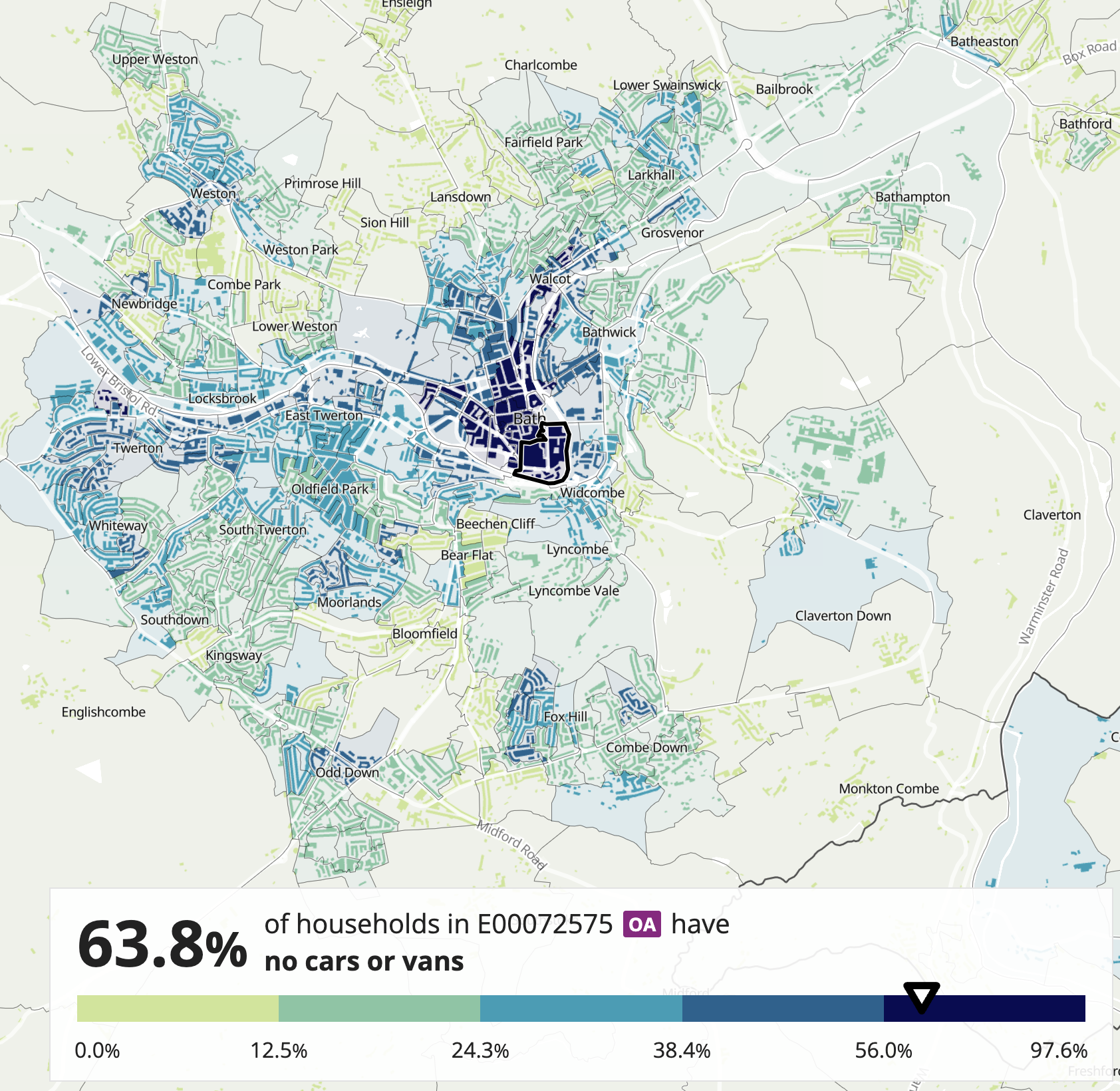
It is also important to remember that for many households, being car free is a choice enabled by safe walking, wheeling, and cycling infrastructure. The ascendency of the eBike as a real alternative to owning a car I suspect has also played it’s part, particularly in our hilly city.
Making sure minority groups are heard
The government recently published “A best practice guide to community consultation and engagement” which specifically highlights the weaknesses of online consultations and provides advice on inclusive engagement and engaging with hard to reach groups.

“3.8. Hard-to-reach groups is a term used to describe sections of the population who, for a variety of reasons, may be more difficult to involve in community engagement than most people. The best way to approach the engagement of hard-to-reach groups is simply to develop your approach to make sure those groups can participate and are represented. This may require specialist resources, including external support or partnership working with colleagues from other parts of your organisation. This is vital, as it ensures an inclusive, open, fair and empowering approach to community involvement.”
“ 3.7 … Similarly, it is also important to remember that inclusivity is a broad term. For example, it may be that the scheme you are developing will benefit children travelling to school and engaging them in the design process will provide huge benefits to the scheme by balancing the views of older people.”
Understanding bias
It is good to see that the council’s recent decisions on Liveable Neighbourhoods over the last two years has demonstrated that they understand the biases inherent in online consultations. Although there is some criticism that the council are over-consulting on what are relatively small schemes, it is excellent that they are not making decisions solely on the results of online consultations inline with the new guidance.
The council should be praised for doing much of this before the guidance was published.
Weathervane Politics is still a big problem
Anecdotal evidence suggests that some councillors, who rightly have a major voice in emerging issues, may tend to take onboard representations from vocal local individuals and interest groups to form a basis of their position to respond to consultation proposals.
We have seen a phenomenal £90m 12 mile scheme that would have enabled a child to cycle from Brislington to the centre of Bath and a vital Keynsham bypass bus/rail/High Street interchange placed on hold because of online consultation responses to a 2 mile section where a bus lane was proposed.
We see councillors not able to see beyond the ballot box when they see those headline consultation response figures.
We’ve seen LTN decision call-ins based on headline results of online consultations with the decisions to reject the call-in be being called undemocratic.
Taking all views into account
Given the Active Travel England guidance, it perhaps behoves us all, but particularly cabinet members, officers, and ward councillors, to continue to look to improve upon our working practices by ensuring that consultation in its widest sense be conducted so that everyone has an equal shake at having their say, rather than the loudest, shoutiest voices sometimes winning the day.
 walkridebath.org.uk
This is rubbish – an excuse for avoiding public opinion. Remember Doublethink in ‘1984’ ?
Comments section is not operational
>
LikeLike
The guidance asks councils to ensure consultation is inclusive and the views of hard to reach minority groups are heard.
I’m unsure why you would oppose that.
LikeLike