

I bumped into Cycling Mayor Pete Dyson at the excellent ebike trial day at Combe Down cycle track (returning next year if you missed it). He reminded me of the big achievement of getting the condition of North Road firmly onto the council agenda and actually getting something done about it. So here is a guest blog from Pete on the power of engagement and protest! Take it away Pete….

Smoothing out North Road – what this bumpy road revealed about potholes, politics and safety priorities
Back in July 2023, when I started as Bicycle Mayor of Bath, it was the sheer volume of emails about injuries and a lack of action on North Road that put it the top of my agenda.
In principle, I’m not a huge advocate for protests and marches, perhaps it’s the transport researcher in me that hopes a dispute over transport policies can be settled through evidence, dialogue and funding. But I soon learnt how concerns about potholes and injuries to cyclists descending North Road had been shared for many years and led to little action.
This included members of staff at University of Bath at the top of hill, who’d spent decades cycling and up down, but still got caught out in in the dark by the rough surface (in two cases leading to injuries requiring a trip to hospital). It was also parents who not only witnessed their children being injured, but also suffered the stress each day of worrying if their loved ones would get home safely.
The state of the road was poor and the long-term approach to selectively ‘patch’ the biggest potholes most problematic for vehicles never addressed the rutted and rough surface that remained a hazard to cyclists. That approach persists for as long as the criteria used by highways officials (around the UK) prioritises big holes that affect axled traffic. This is known as the International Road Roughness index (IRI) that tests roughness using a quarter car-model, reflecting mass, tire size and suspension characteristics of a motorised vehicle, so neglects the impact of the surface on cycling experience (EU InterReg Standards).
In this day and age, it is my view that leaving cycle users out of the question is not acceptable planning policy. Inaction compromises safety and blocks the choice for people (especially children) to cycle at all. It’s a crying shame, because qualitative research with new and experienced cyclist shows road roughness is a big barrier for people’s willingness and enjoyment of cycling (McIllroy, Plant and Stanton, 2021). It makes the trip harder, riskier and requires skill and concentration to stay upright.
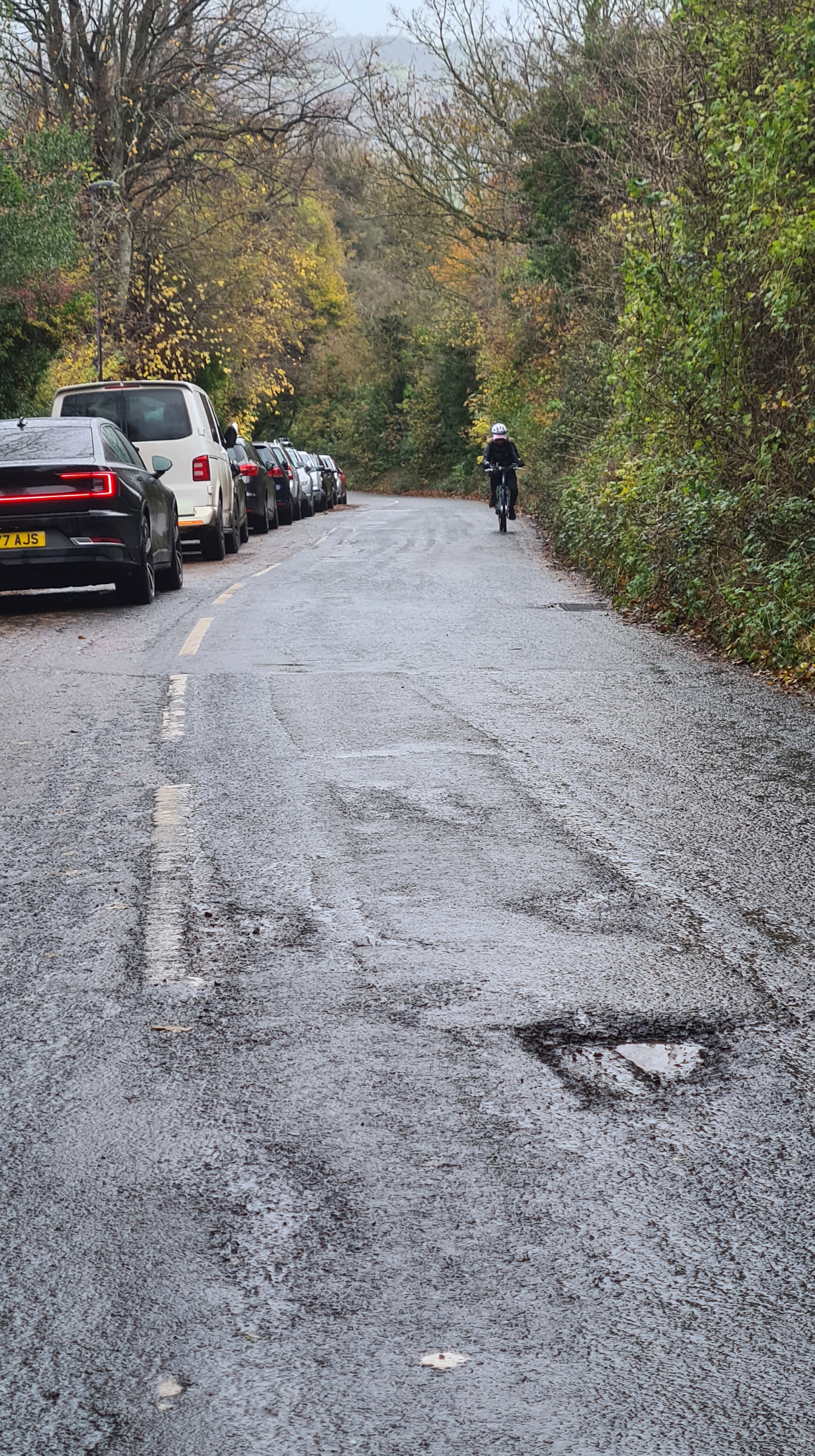
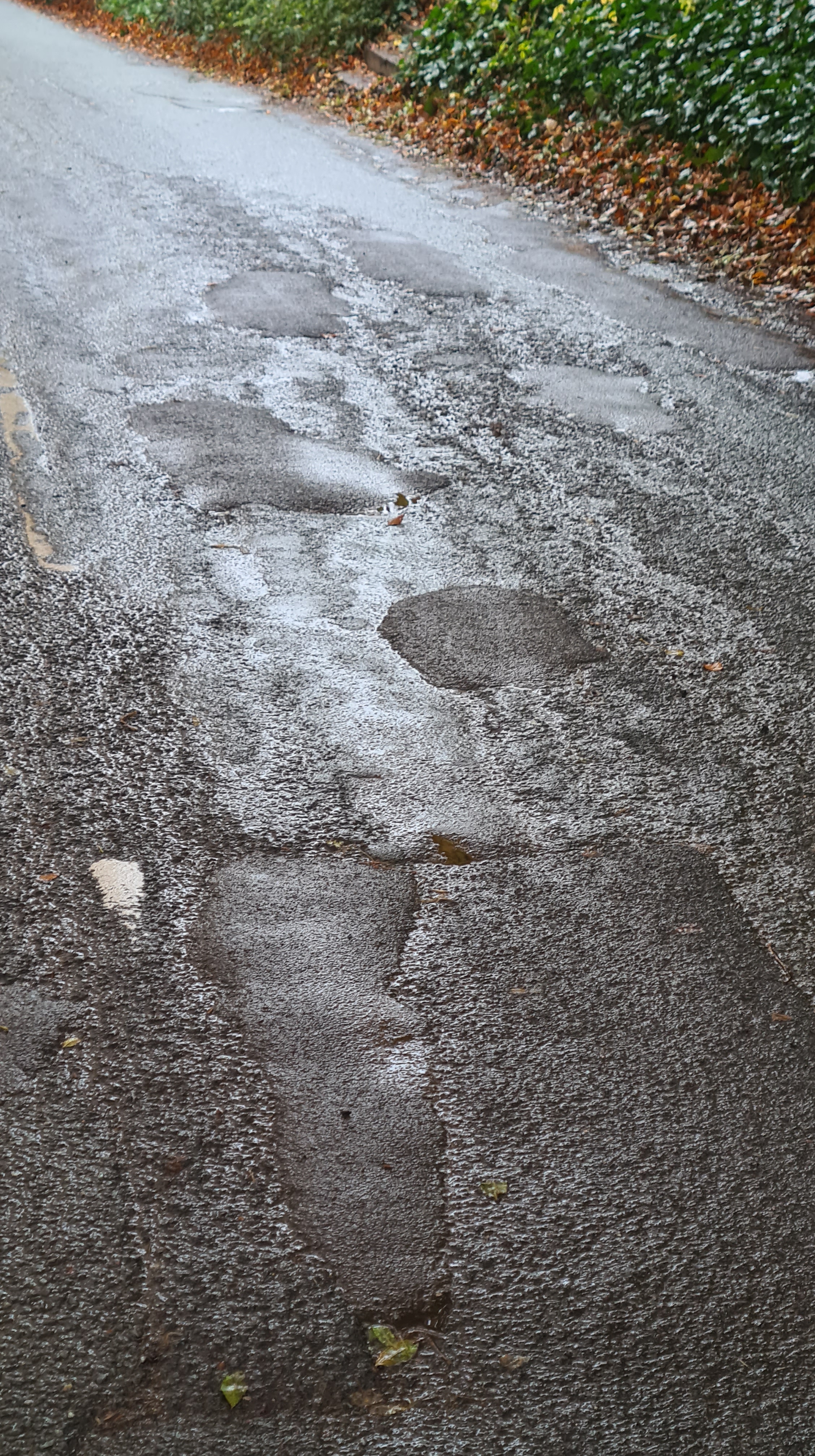
Why is this road so significant? Well North Road is one of three roads from Bath city up to Claverton Down. It has a big secondary school at the base a huge university at the top and links north and south Bath together. Significantly, it is the quietest and shallowest of the three (Bathwick and Widcombe are steeper, more traffic and both have bus routes) and is therefore preferred by many cyclists. Its popularity hasn’t gone unnoticed and calls for a modal filter in 2020 led to heated debate and significant local council turmoil. The road is narrow, on-road parking is abundant and large detached houses and a golf course connect onto it. Suffice to say there was local opposition, no reduction in danger from motor vehicles, politicians fell out and no movement to re-surfacing the road.
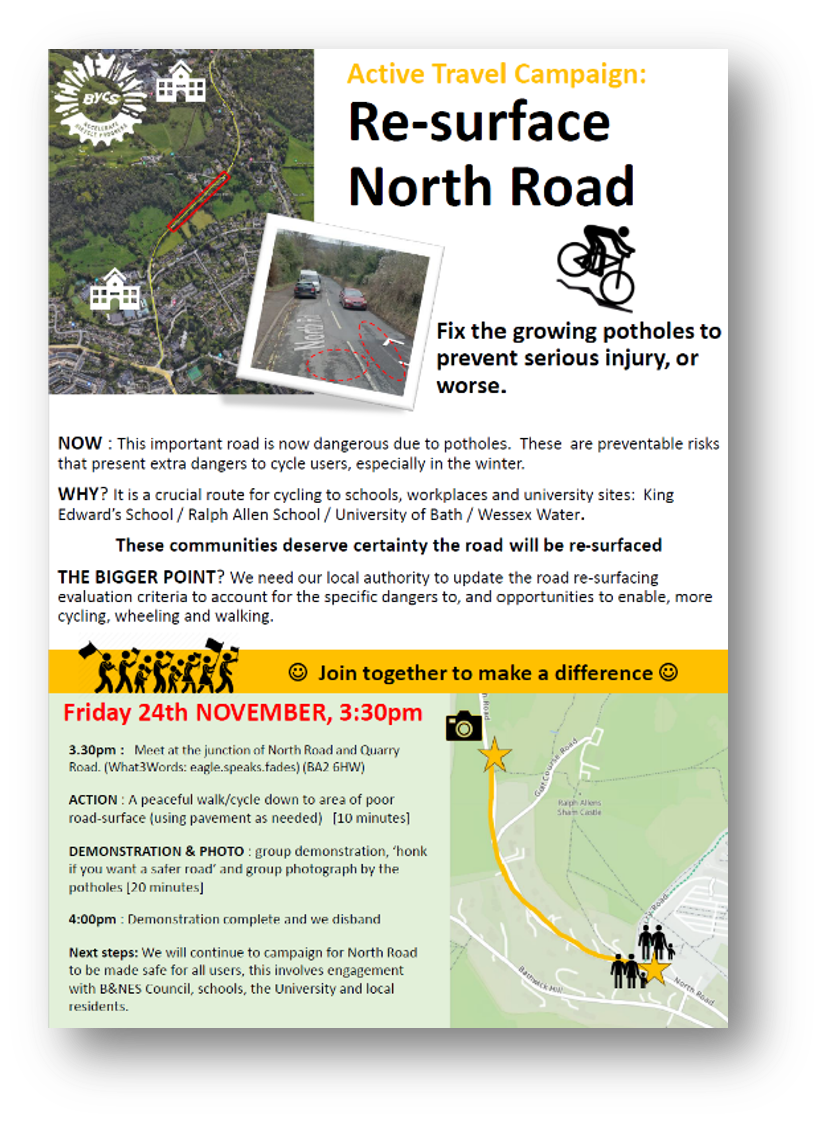
With no action or clarity in the years since, even the persistent calls for re-surfacing weren’t being met with confirmed budgets and dates. My action was to create a campaign poster explaining the issues and promoting a peaceful protest march on Friday 24th November. Guidance on organising a peaceful protest (like notifying the police in advance) was much appreciated from Councillor Saskia Heijltjes and Councillor Joanna Wright, as was their support on the day and ability to raise the profile of the event within BathNES Council. To their credit, the Cabinet Member for Highways, Councillor Manda Rigby, was also happy to listen to concerns beforehand too.

It proved to be a positive experience, coinciding with road safety week. About 30 people gathered, discussed experiences and passers by seemed supportive (not least because potholes are clearly a pain when driving too). The local Extinction Rebellion representative kindly re-purposed their bright pink banner, much to the surprise of some on the protest, who would never otherwise be likely seen on at XR march. Safety and cycling was a uniting force. The Bath Chronicle covered the story, and our campaign was timed appropriately to influence the BathNES Council budget allocation for 2024 road re-surfacing.

The campaign pushed for re-surfacing in May, but with some irony, the highways department felt school traffic flows should not be disrupted (perhaps not seeing our point of view that it was school and university cycle ‘traffic’ that needed to be made safer).
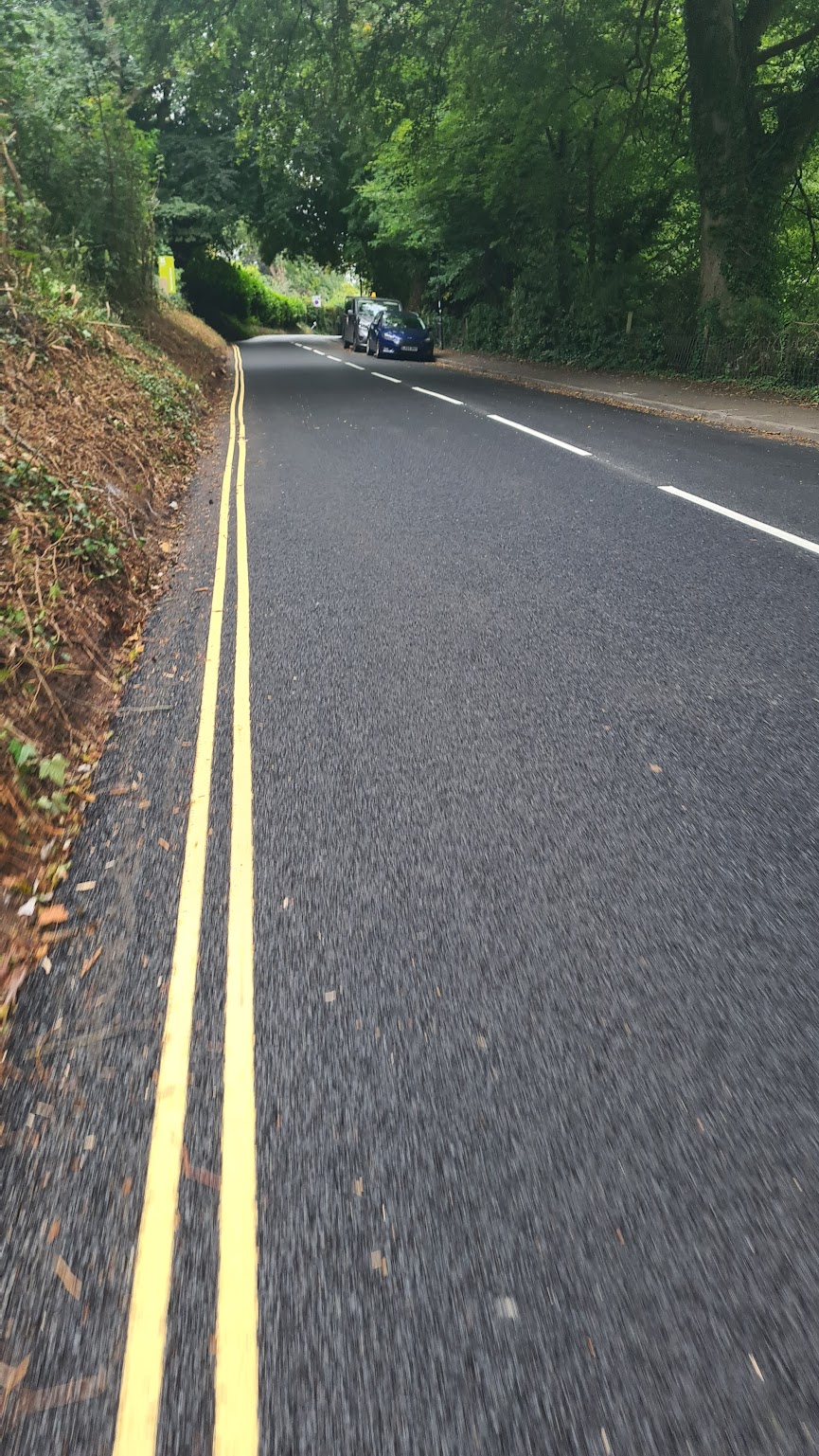
The works were scheduled and completed on Monday 19th August 2024, involving a stretch of about 800 metres to be fully re-surfaced. It’s now perfectly smooth and so much better. On the plus side, it’s come just in time for the new school and university terms and I’ve seen joy and relief expressed on the Bicycle Users Group as long-standing cyclists can descend more safely.

What next? I think the whole story reveals several things (1) road re-surfacing criteria needs be updated to account for context-specific risks to cyclists, like the road steepness and overall roughness (not just large axle damaging potholes). (2) that active travel should aim for full measures of safety, like protected cycle infrastructure, but not settle until more incremental improvements are made. (3) road re-surfacing shouldn’t all happen in the summer holidays for fear of ‘disrupting traffic’ when the goal is urgent safety and improvement to children’s travel to school.
Further improvements? To my eye, the road dimensions look tight for a protected cycle-lane (that adhere the new and improved UK standards) as well as two-way traffic and a pavement. I would prioritise further improvements to North Road as follows; the removal of on-street parking (that currently forces cycles into oncoming traffic when descending), improved street lighting, improved pavement for pedestrians, and improved drainage to prevent water-run off and further road degradation. Longer term, we have to ask ourselves if the volume of motor traffic on this (and indeed all routes to the university from the city centre) where there is no protected cycling infrastructure is compatible with the council’s stated aims to enable active travel?
References;
- InterReg North West Europe: Design principles Surface quality https://cyclehighways.eu/design-and-build/design-principles/surface-quality.html
- McIlroy, R. C., Plant, K. L., & Stanton, N. A. (2021). Thinking aloud on the road: Thematic differences in the experiences of drivers, cyclists, and motorcyclists. Transportation research part F: traffic psychology and behaviour, 83, 192-209. https://www.sciencedirect.com/science/article/pii/S1369847821002187
 walkridebath.org.uk