
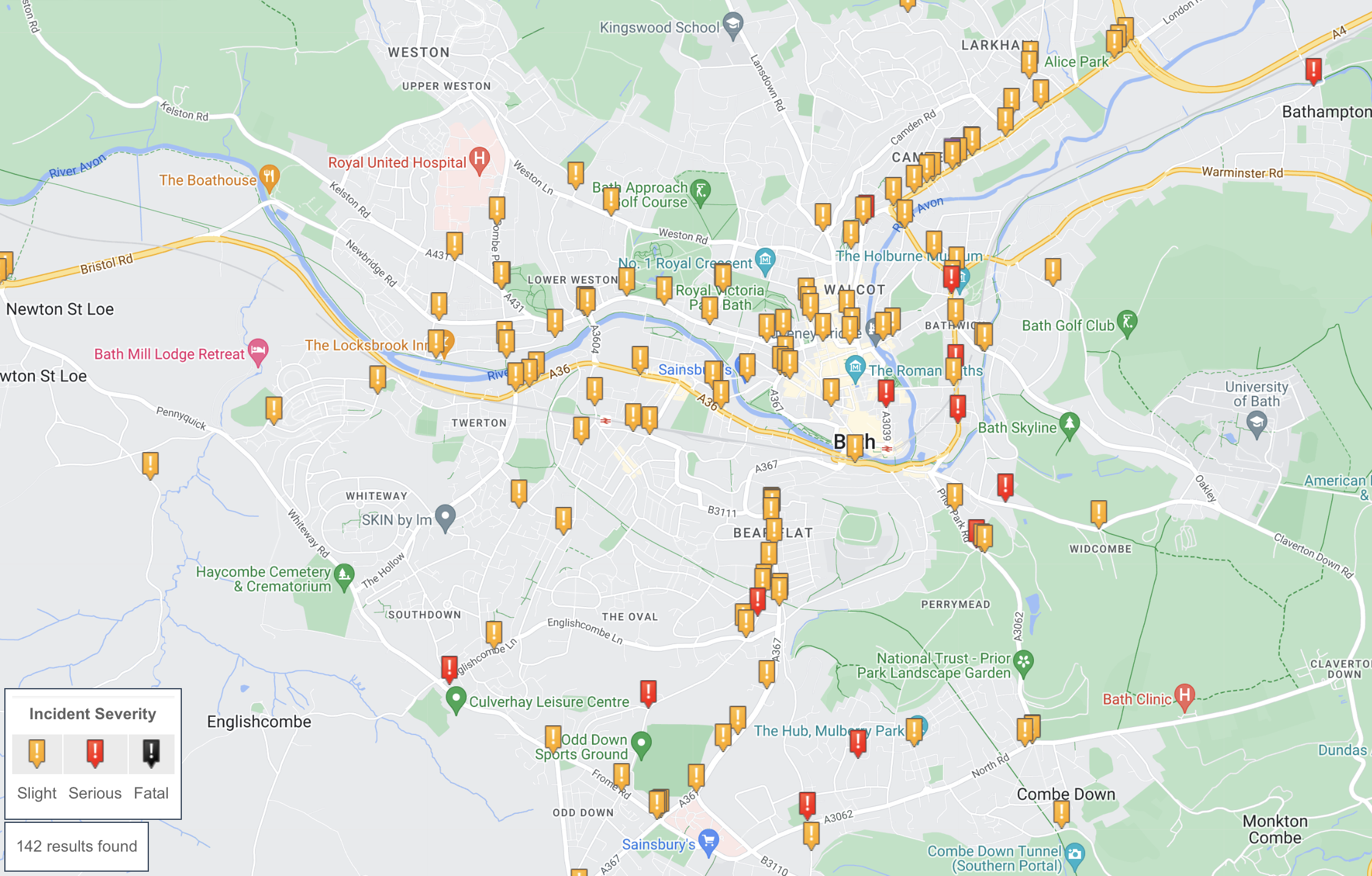
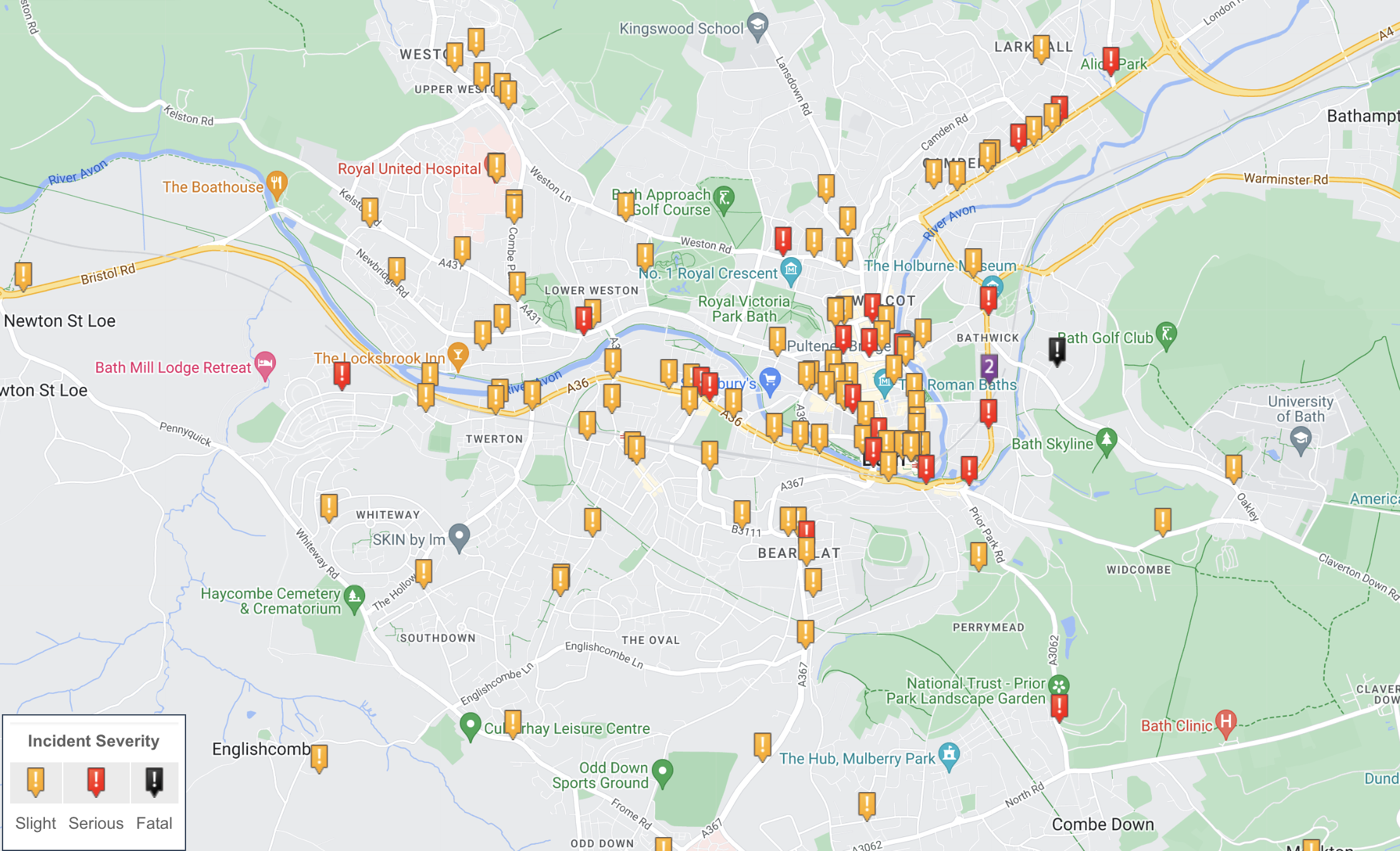
A couple of people I know have been hit by a driver while cycling around Bath, unfortunately. On some occasions, their injuries were worse than they initially thought, impacting their health, as well as professional lives. This made me think about how little I know about this, in case this would ever happen to me, my partner, or my children.
A few months ago I made a connection with local law firm LWK Goodman – they interviewed me for a podcast and asked me about my ideas on how to make cycling safer in Bath. The podcast will hopefully be published soon – will post on here when it’s available!
So I decided to ask them if they could fill us all in on what to do if we get hit (or come off our cycle) when cycling. Let’s hope you will never need this advice!
Here’s the advice that Mark Hambleton, specialising in cycling claims at RWK Goodman, shared with me:
Navigating the aftermath of a cycling accident collision
It goes without saying that cycling is one of the most a sustainable, environmentally friendly, and health-conscious modes of transport available to us. In my view, we should do much more to increase cycling numbers so that we begin to make more significant cultural changes on our roads.
Cyclists are clearly vulnerable road users. Without stating the obvious, pedestrians, cyclists and horse riders are more vulnerable to injury than those travelling in cars, vans or lorries.
The introduction of the hierarchy of road users (in the updated Highway Code) recognises this, and makes it clear that those in charge of vehicles that can cause the greatest harm in the event of a collision bear the greatest responsibility to take care and reduce the danger they pose to others.
I am a solicitor specialising in bringing civil claims for injured cyclists and on behalf of families who have suffered a bereavement.
I have been asked to write this short article about the appropriate steps cyclists should take following a collision on our roads. Hopefully these suggestions will be useful reminders of practical things to do which may be beneficial when it comes to subsequent criminal proceedings and/or civil claims.
What should I do after a collision?
Ideally, if you are involved in a collision, you should take the following steps:
- Exchange details with the other party. Take the driver’s full name, address, telephone number, vehicle registration, and insurance details. Also, take note of the driver’s appearance and any passengers.
- Take photographs of the scene, the damage to vehicles and bikes involved, and document any injuries sustained.
- Seek medical treatment. The treatment itself is the most important thing but, secondary to that, contemporaneous records such as hospital records can be helpful later on.
- If possible, speak to witnesses, make a note of their names and contact details. Independent witness evidence can be crucial in cases where the parties involved in the collision dispute the circumstances.
- Contact the necessary emergency services, often the police and an ambulance. If the police do not attend, you should report the collision yourself as soon as possible on 101 or online.
Preserve any evidence such as your bike, helmet, lights and digital data such as Strava or Garmin information.
What should I avoid doing following a cycling collision?
In addition to the suggestions above, there are some things to avoid doing too. It’s often best to avoid knee jerk reactions such as social media posts or speaking to the press, even when the collision wasn’t your fault. It’s important not to inadvertently prejudice any criminal or civil proceedings that might follow the collision.
Discussions with the driver should be limited to the exchange of essential details. Arguments or protracted discussions about blame, injuries or other potentially contentious topics are best avoided immediately after the collision. You may be assigned a police officer to support you. It is important to take their advice too.
It’s best to seek specialist legal advice about a civil claim rather than accepting compensation direct from the driver or their insurer. This minimises the risk that you might be undercompensated, especially if the full extent of your injuries is unknown. Do not sign up to a retainer with a legal representative until you know who you’re dealing with and fully understand what is being agreed.
What should I do if the driver fails to stop at the scene of the collision?
If the driver involved in the collision fails to stop at the scene and/or does not exchange details then call the police. If the chance presents itself, also make a note of the vehicle registration number, the vehicle and the driver (or other occupants).
In situations where a driver fails to stop at the scene, such as ‘hit and run’ cases, or in equally troubling circumstances when a driver is uninsured, one could be forgiven for thinking there is no possibility of a successful civil claim for compensation. Fortunately, the Motor Insurers’ Bureau (MIB) exists to provide compensation to people injured by untraced or uninsured drivers.
Is there anything in particular I should do if I’m carrying a child on my bike or if my child on their own bike is involved in a collision?
The advice doesn’t really differ in these circumstances. In cases involving children, whether they’re accompanying you on your bike or cycling independently, from a parental perspective, it is perhaps even more important to have them medically examined. Keep a close eye on them because often you know your child best and an injury may not be obvious, and a child may find it difficult to express how they are feeling or any pain they may be experiencing, particularly if they are upset and in shock.
Parents or guardians should be aware that a civil compensation claim on behalf of a child (aged under 18 at the time of the accident) can be started on their behalf at any time before their 18th birthday. Once the child turns 18, they will have a further three years until their 21st birthday which will be the limitation date. However, it is usually advisable to get legal advice on making a personal injury claim on behalf of a child at the earliest opportunity.
What should I do if I think I’m uninjured following a collision?
Keep things under review. Some symptoms can be subtle and some can take time to recognise. There’s no harm in attending a medical consultation at the time, even if it’s just for peace of mind.
It is still worth liaising with police over a criminal prosecution if, for example, you feel a driver was negligent for causing a collision. It is also worth taking legal advice on recoverability of financial losses arising from the collision.
What should I do if a pothole (or some other road defect) is the cause of the accident?
It’s perhaps uninspiring, but it’s vital to document the defect. Take very clear photographs from different angles showing the dimensions and condition of the pothole and surrounding area. Use a ruler or tape measure in some of the photographs to clearly show the dimensions (length, width and depth) of the defect.
Time is of the essence to a certain extent. When it’s safe to do so, take the photographs before the potholes are repaired or other changes are made to the area. If you are unable to take the photographs yourself, it is worth asking a family member or friend to do it for you.
You should report the pothole to your local council and keep a note of when you reported it. You can report to your local council online or by phone. You can report a pothole in Bath & North East Somerset here Report road damage or obstructions | Bath and North East Somerset Council (bathnes.gov.uk) We can help other cyclists and hopefully prevent future accidents by reporting potholes as and when we spot them whilst out cycling.
How does the compensation claims process work?
The police and CPS will provide guidance on criminal proceedings.
Injured cyclists (or the families of fatally injured cyclists) have the option of pursuing a civil claim for compensation. The civil claim is not contingent upon a successful criminal prosecution because of the different tests that are applied in civil and criminal cases. In criminal cases the burden of proof is higher i.e. beyond reasonable doubt’. In civil claims there is a lower burden of proof i.e. on the balance of probabilities.
It is sensible to obtain legal advice someone specialising in personal injury claims for cyclists.
Legal advice is often provided on a ‘no win, no fee’ basis. You shouldn’t be charged for the initial consultation and, assuming appropriate steps are taken, you should not be any worse off financially at the end of a claim, even if it is unsuccessful. The complexity surrounding the circumstances of the collision and severity of the injuries are usually the two factors that influence the duration and outcome of the claim.
If you are successful with liability, the amount of compensation you will receive will depend upon the extent of your injuries and the total amount of your financial losses (both past and future losses).
If a claimant is found to be contributory negligent, their damages will be discounted (reflected by a percentage figure) to reflect any negligence on their part which contributed to the injuries suffered. This is good reason to obtain legal advice.
Part payment may be obtained before the case can be settled on a full and final basis. That can be helpful to fund immediate expenses or costs such as loss of income, medical treatment or replacement of your bicycle.
Mark Hambleton is a Partner, specialising in cycling claims, in RWK Goodman’s Personal Injury team. T: 01225 730 214
 walkridebath.org.uk